Shopify playbook · 9 min read
7 Shopify Product Page A/B Tests to Increase AOV
Average order value grows when shoppers can confidently find a better-fit cart—not when a storefront hides the base price or overwhelms them with offers. These product-page tests focus on relevance, clarity, and customer-respecting upsells.
Seven product-page hypotheses
- Bundle clarity: test a curated complementary set against a generic “frequently bought together” module.
- Quantity framing: test a quantity selector with clear per-unit savings where the offer is real and easy to understand.
- Threshold progress: test helpful shipping or gift-threshold progress that never obscures the actual cart total.
- Variant guidance: test a size, material, or compatibility guide next to the selector to reduce incorrect purchases.
- Cross-sell relevance: test accessories chosen for the viewed product rather than a global bestseller list.
- Delivery confidence: test clear arrival and returns information near the purchase decision.
- Value comparison: test a concise comparison between standard and premium configurations.
Each is a starting hypothesis, not a universal best practice. A bundle can raise AOV while lowering conversion or increasing returns; look at the whole outcome.
Use AOV with the right guardrails
Revenue per visitor is often a better primary decision metric than AOV alone because it accounts for conversion rate. Track AOV, conversion rate, units per order, gross margin, discount cost, return rate, cancellation rate, and customer-support contacts. An AOV lift that comes from pushing the wrong product or an aggressive discount is not durable growth.
Use eligible product-page visitors for sample planning, not all store sessions. If a product has low traffic, test a shared component across a coherent collection only if the customer question is the same.
Shopify-specific QA
Preview every variation on mobile, with sold-out variants, regional pricing, subscriptions, discount codes, accelerated checkout, and your installed apps. Preserve accessibility and avoid DOM changes that break theme behavior. Keep price and promotional claims accurate in every state.
Diti supports storefront experimentation on product, collection, cart, and landing pages. It does not currently provide a dedicated Shopify checkout extension, so keep checkout-specific claims and tests within the capabilities of your plan and tooling. Our Shopify A/B testing guide explains those boundaries.
Turn one idea into a valid test
Start with product analytics, reviews, and support questions to identify a real decision barrier. Define one primary metric, meaningful guardrails, audience, and MDE before launch. Do not run all seven ideas together; a stacked page makes it impossible to learn which change mattered.
For cart and checkout-adjacent hypotheses, see these e-commerce checkout test ideas. The strongest AOV work protects customer trust while making the right next purchase easier to understand.
Preview a product-page variation before launch
A visual editor should help a team review one meaningful change before it reaches shoppers. In this example, the storefront editor is replacing a hero image while keeping the control and variation easy to inspect.
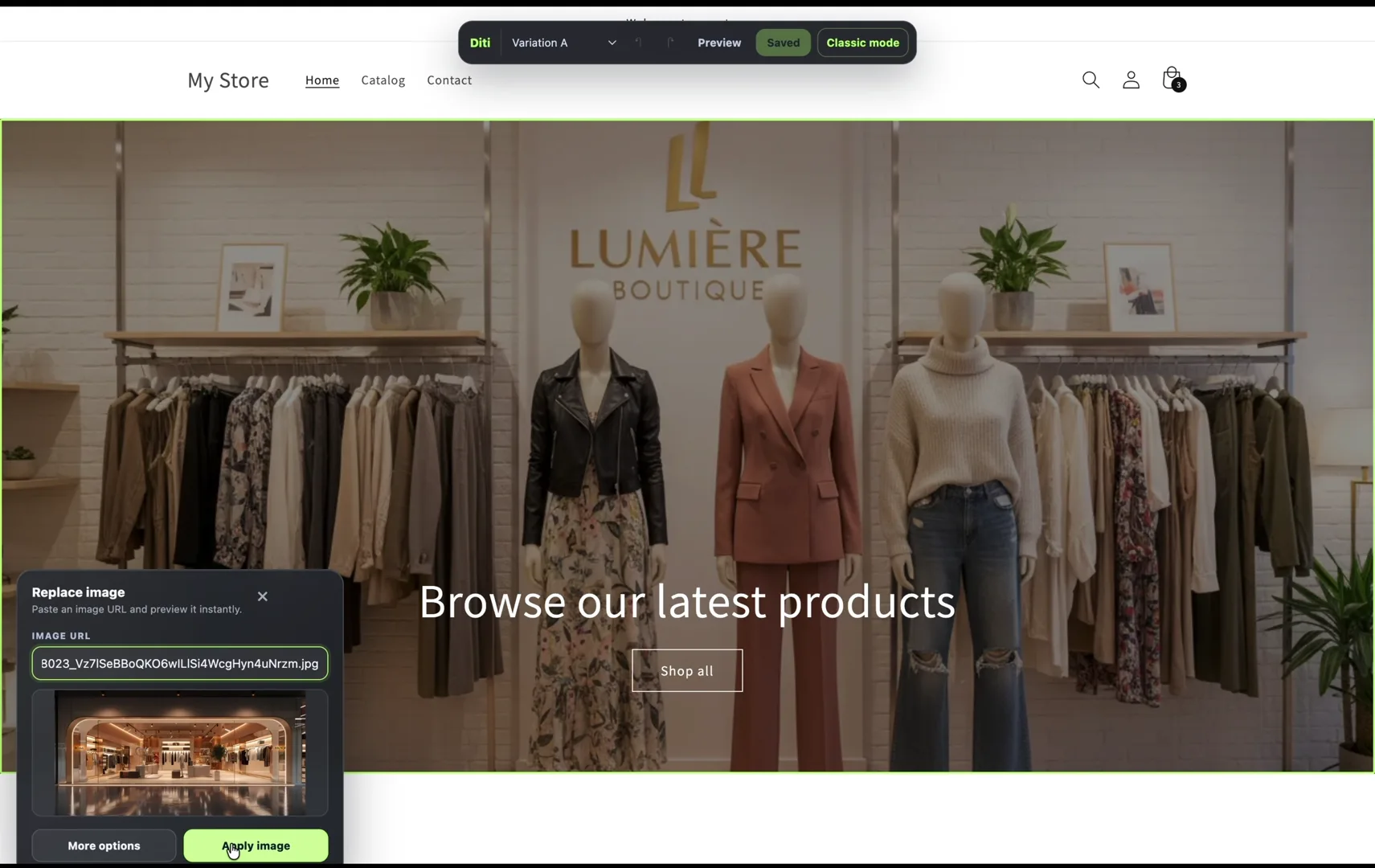
For a product page, the same discipline applies to product media, value comparison, or delivery reassurance: make one intentional change, review every relevant state, and avoid combining multiple ideas into the same test.
Put the guide into practice
Build your next experiment with Diti.
Turn a focused customer question into a test your team can preview, launch, and learn from.
Start testing with Diti ↗About this guide
Reviewed by Diti's experimentation team
Diti's product and experimentation team maintains these guides for people planning, launching, and evaluating real product experiments. We update them as our workflow and platform guidance evolves.
Keep learning