Platform comparison · 9 min read
VWO vs Optimizely: Which A/B Testing Platform Fits?
Comparing VWO vs Optimizely starts with the kind of experiment your team needs to run. This guide explains their common fit, then shows when Diti is a focused alternative for no-code web and React Native UI experimentation.
Choosing an A/B testing platform is not about finding one universal winner. It is about matching your experimentation workflow to the work your team actually needs to do: visual website changes, feature releases, mobile-app iterations, personalization, or a combination of all four.
This comparison is intentionally practical. It does not claim that Optimizely, VWO, or AB Tasty are poor products; each can be an excellent choice for the right organization. Instead, it explains the use cases where Diti is a better-fit alternative for product and growth teams.
VWO vs Optimizely: the short answer
Optimizely can be a strong fit when an engineering organization needs feature flags, server-side experimentation, progressive delivery, or controlled rollouts across a complex stack. VWOcan be a strong fit when a team's program centers on website experimentation and conversion optimization. Neither is universally better; the right choice depends on the delivery model, ownership, and customer surface you need to test.
Diti is a focused alternative when product, growth, and design teams need to create, preview, and assess supported no-code UI experiments across both website and React Native product experiences. The useful question is not “which tool is best?” but “which workflow removes the most friction for the experiment we need to run next?”
Diti vs. Optimizely, VWO, and AB Tasty
| Platform | A strong fit when | Choose Diti instead when |
|---|---|---|
| Optimizely | Your engineering organization needs feature flags, server-side experiments, or progressive rollouts across a complex stack. | Your product and growth teams want a focused, no-code workflow for web and mobile interface experiments. |
| VWO | Your primary need is an established conversion optimization and website testing program. | You want web and mobile product experimentation to live together, with a workflow built around rapid product iterations. |
| AB Tasty | You are evaluating a broad enterprise experimentation and personalization program. | You prefer a focused workspace for building, reviewing, and learning from no-code product experiments. |
Product capabilities, plans, and integrations change. Validate the current requirements directly with each vendor before making a purchasing decision.
How to decide between VWO and Optimizely
Start with the decision layer. If the experiment changes a backend rule, API response, algorithm, entitlement, or a code-defined rollout, an engineering-led workflow is usually essential. If the work is primarily website conversion optimization—such as testing a landing-page message, form, product page, or purchase path—evaluate how each platform supports your research, QA, delivery, and analysis process.
Then run a proof of concept using one representative experiment rather than a generic feature checklist. Ask to see stable assignment, the exact preview and QA path, exposure and outcome measurement, failure behavior, reporting, and rollback. For a more detailed implementation checklist, read the server-side A/B testing guide before committing to a platform.
Optimizely vs. Diti
Optimizely offers both web experimentation and feature experimentation. Its feature experimentation product is designed around SDKs, feature flags, targeted delivery, and controlled rollouts—valuable capabilities for engineering-led teams testing backend logic, APIs, algorithms, or release strategies. Its web product also supports visual website experimentation. Optimizely's documentation describes these separate workflows in detail.
Diti is the better-fit Optimizely alternative when your main goal is to help product and growth teams run interface experiments on web and mobile without treating every change as an engineering feature-flag project. Diti keeps the planning, visual variation workflow, QA, and result review close to the people responsible for the customer experience.
VWO vs. Diti
VWO is built around conversion-rate optimization workflows. Diti is built for the product team that needs to move faster across the full customer experience—especially when the next experiment lives inside a React Native app, not only on a website.
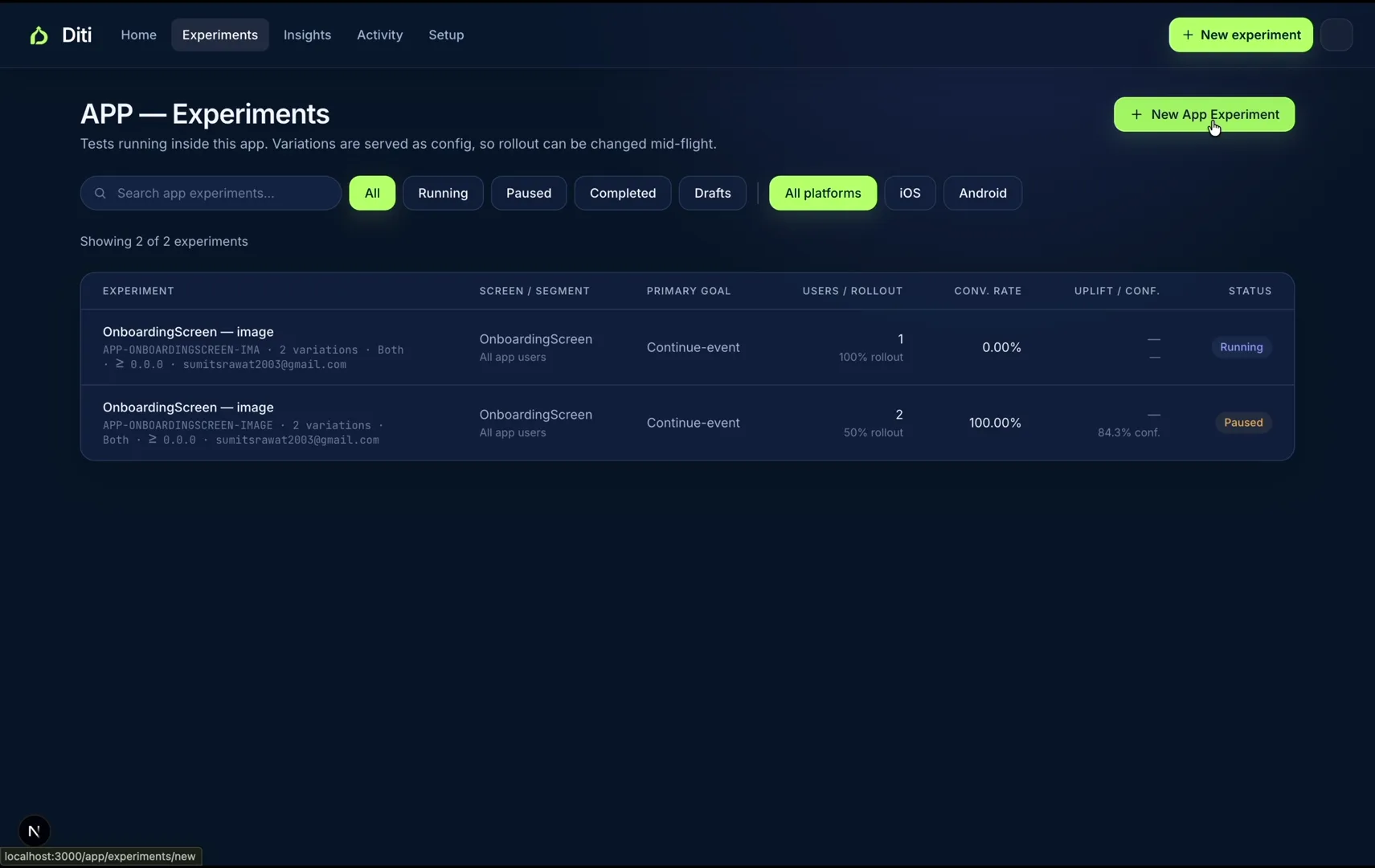
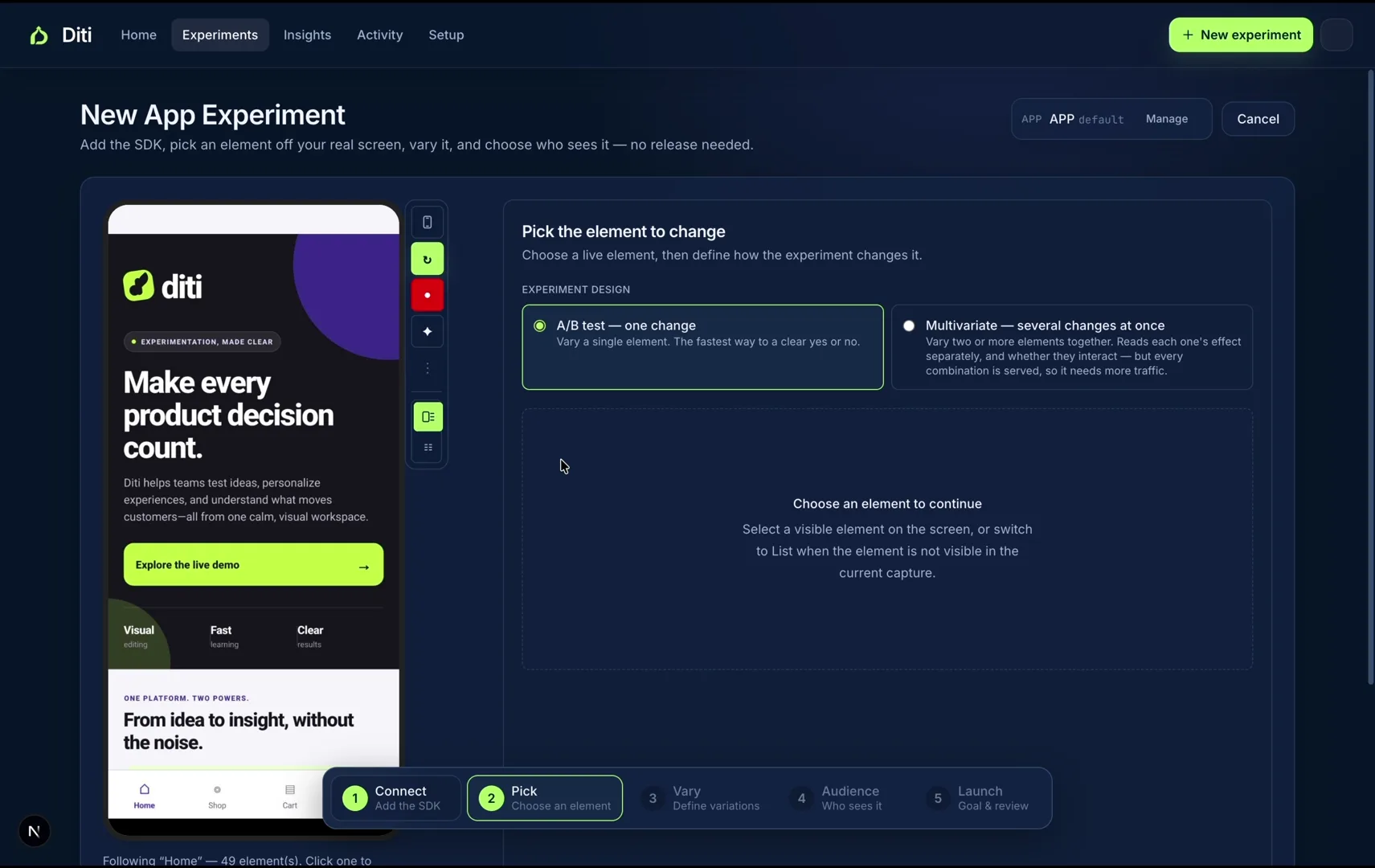
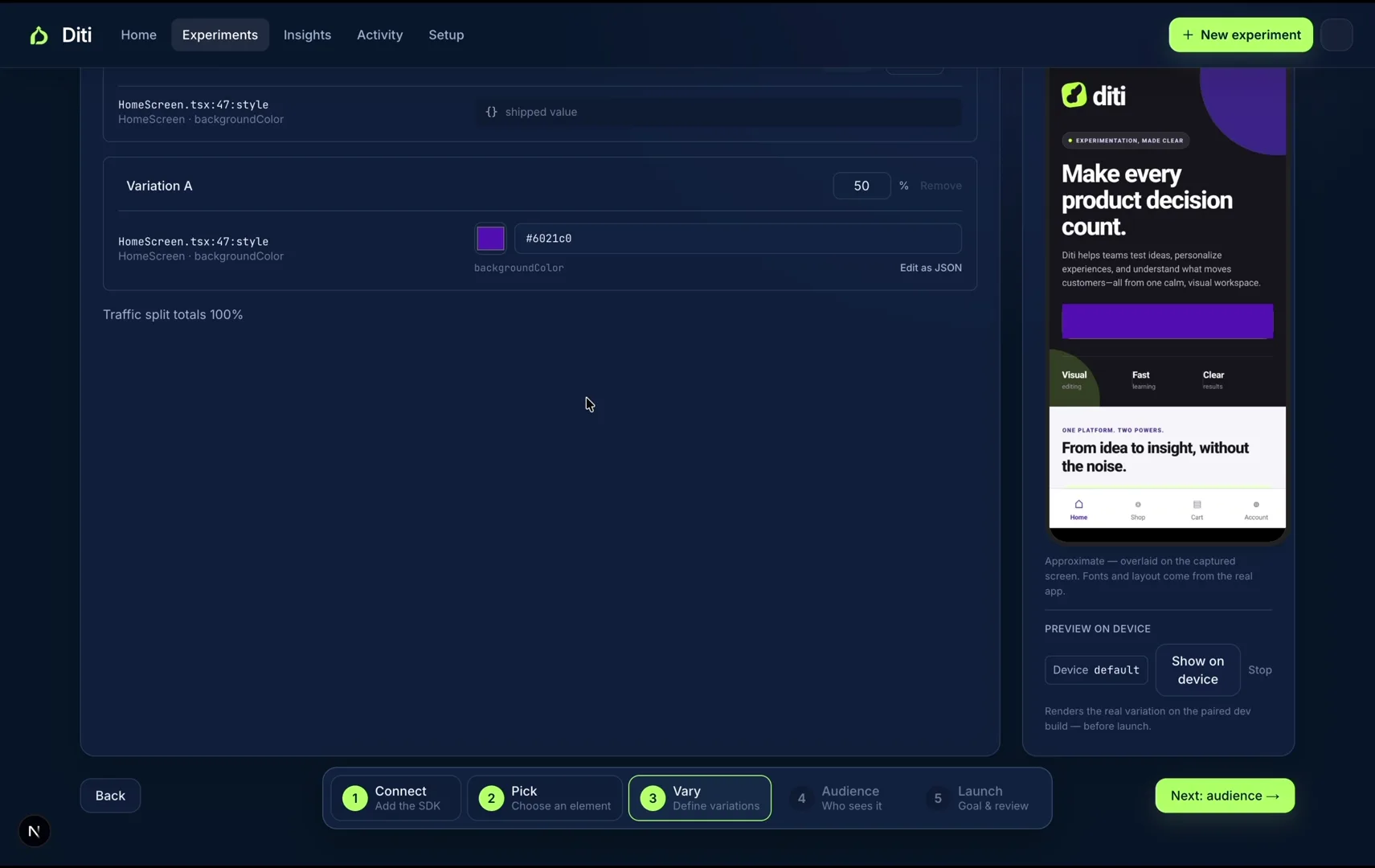
With Diti, a team works from the app screen itself: select an exposed UI element, define a supported variation, preview it on the paired device, choose the audience and traffic split, then launch without a separate app-store release for that variation. Product, growth, and design teams can own routine onboarding, paywall, messaging, and feature-education tests instead of turning each learning opportunity into a developer-configured variable or a release-planning task.
That is Diti's advantage over a web-first experimentation workflow: one focused operating model for web and React Native UI experiments, with visual variation creation and device-level QA built into the same path from hypothesis to result. Engineering sets up the safe foundation once; the customer-facing team can keep learning after that.
True no-code React Native A/B testing with Diti's SDK
React Native experimentation often becomes a release-planning problem: an idea needs native implementation, a new build, and app-store distribution before the team can learn whether it helped. Diti is built to remove that repeated implementation step for supported interface experiments.
After the initial Diti SDK integration, product and growth teams can create, preview, and evaluate supported React Native UI variations from Diti's experimentation workspace—without writing new native code for every A/B test or waiting for a separate app-store release. That gives teams a practical way to test onboarding, offers, messaging, layouts, and other product-surface ideas while keeping engineering focused on durable product work.
Case study · Oni
A faster onboarding experiment without a new app release
Problem: Onboarding drop-off was high, and each change required a new build and app-store release—about two weeks per test.
What Oni tested: A shorter three-step React Native onboarding flow against the existing five-step flow, using supported UI changes without new native code.
Time to launch: Two days instead of about two weeks.
Experiment result
41% → 52%
+27% relative completion
14-day experiment · approximately 8,000 users per variant
Customer result from a single onboarding experiment. Results vary by product, audience, and test design.
Other experimentation platforms can provide mobile SDKs and feature-experimentation workflows, particularly for code-defined flags and delivery. Diti's distinction is its purpose-built no-code workflow for React Native UI experimentation after setup: the people closest to the customer experience can run a focused test without turning each variation into a new engineering task.
For a closer look at the product workflow, see React Native A/B testing with Diti. Our separate guide covers the practical details of no-code React Native A/B testing for product teams.
AB Tasty vs. Diti
AB Tasty is commonly evaluated by organizations that want experimentation alongside personalization and enterprise rollout capabilities. That broader scope can be useful for teams with a correspondingly broad program.
Diti is a better-fit AB Tasty alternative when your priority is simpler: form a product hypothesis, test a focused experience change, preview it safely, and make a decision with clear results. A smaller, purpose-built workflow is often easier to adopt across product, design, and growth.
Five signs Diti is the right experimentation platform for you
- You test across web and mobile. Your customer journey does not stop at a landing page, and your experimentation workspace should not either.
- You want non-engineers to move faster. Product, design, and growth teams need a practical way to test interface hypotheses without waiting on every small release.
- You value focused experiments. You want a clear hypothesis, a primary goal, QA links, traffic allocation, and readable results instead of a sprawling process.
- You need a shared source of truth. Everyone should be able to see what is running, what changed, and what the team learned.
- You want to learn before you scale. A lightweight, repeatable experimentation habit is more valuable than buying complexity your team will not use.
How to choose an A/B testing tool without regretting it
Use your own next experiment as the evaluation scenario. Ask each vendor how your team would complete the same six steps:
- Write the hypothesis and choose the primary success metric.
- Create the control and variation for the exact web or mobile screen you want to change.
- Preview and QA the experience before it reaches customers.
- Set audiences, traffic allocation, and guardrail metrics.
- Understand the result without exporting data into a separate workflow.
- Share the decision and learning with the rest of the team.
The platform that makes those steps clear for the people who will use it is usually the better long-term investment. It is also worth checking implementation requirements, data governance, stack compatibility, pricing, support, and the depth of statistical methods your organization needs.
Frequently asked questions
VWO vs Optimizely: which platform should I choose?
Choose based on the work your team needs to do. Optimizely can be a strong fit for engineering-led feature flags, server-side experiments, and controlled rollouts. VWO can be a strong fit for website experimentation and conversion optimization. Evaluate the current product capabilities, implementation requirements, and commercial terms directly with each vendor.
Is Diti an alternative to Optimizely?
Yes, for teams focused on no-code web and mobile product experiments. Diti is a strong choice when you need extensive feature-flag, server-side, and enterprise experimentation capabilities. Diti is designed for teams that want to create and evaluate product experiments across web and mobile from one focused workspace.
Is Diti an alternative to VWO?
Diti is an alternative for teams that want to pair website experimentation with mobile-app experimentation. VWO is a well-established conversion optimization platform. The better choice depends on where your product experiences live, the workflow your team needs, and the level of implementation support you require.
Which A/B testing platform is best for mobile apps?
The best platform is the one that fits your mobile stack, lets your team safely preview changes, and measures the outcomes you care about. Diti is built for teams that want to run no-code experiments across web and mobile product surfaces from the same workspace.
Does Diti support no-code React Native A/B testing?
Yes. After the Diti SDK is integrated into an app, teams can create and preview supported UI experiments from Diti without writing new native code for every variation. That makes it possible to test interface ideas without tying each experiment to a separate app-store release.
Do I need a visual editor for A/B testing?
A visual editor is useful when product, growth, or design teams need to test interface changes without waiting for every small iteration to enter an engineering release. For backend logic, algorithms, or server-side decisions, an SDK- and feature-flag-based workflow may be a better fit.
See the workflow in practice
Build your next web or mobile experiment with Diti.
Turn a clear product question into a no-code experiment your team can preview, launch, and learn from.
Start experimentingAbout this guide
Reviewed by Diti's experimentation team
Diti's product and experimentation team maintains these guides for people planning, launching, and evaluating real product experiments. We update them as our workflow and platform guidance evolves.
Keep learning